


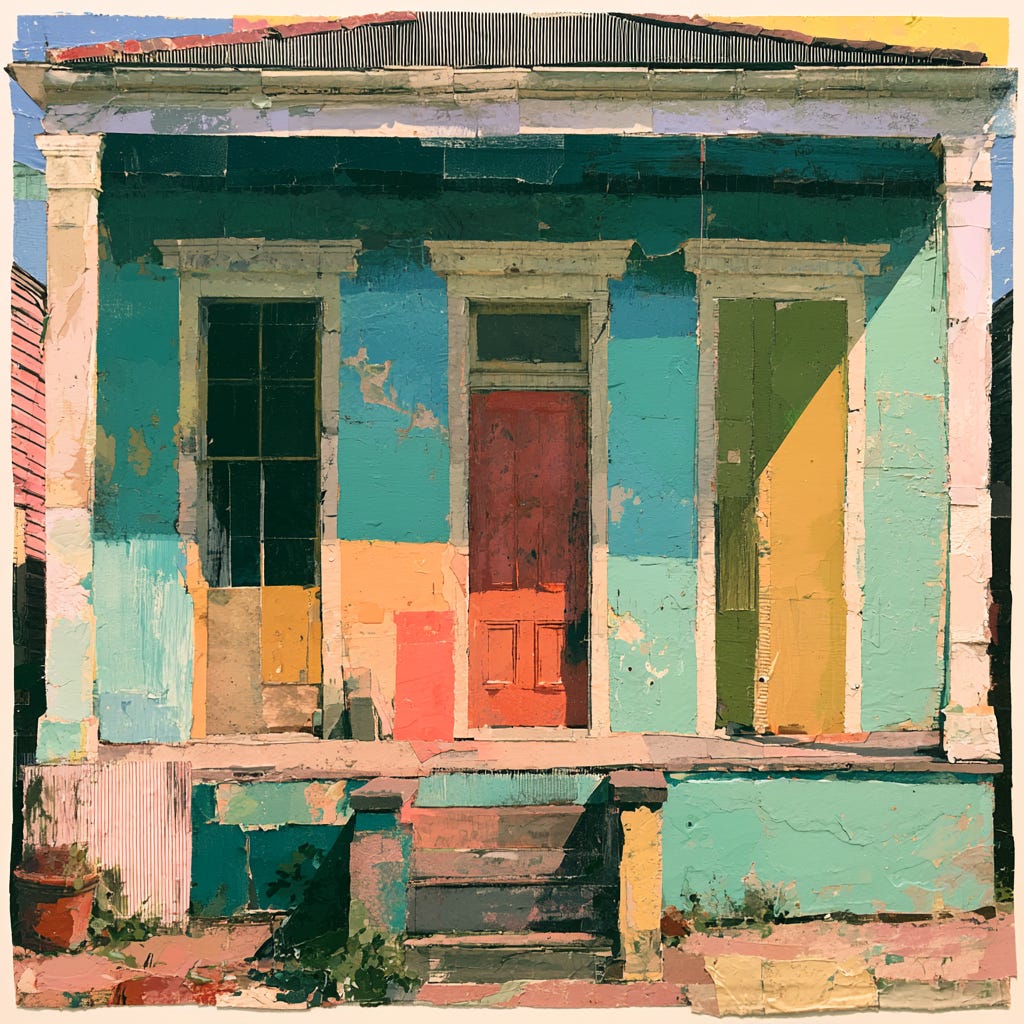
Sketches of fantasy and maintenance
Fantasy is periodic. When it occurs to you, you enjoy it. For the limited time you’re in the grip of the fantasy, you’re pretending.
Reality is persistent. When you are in it, you might not enjoy it very much. You’re inevitably tending to needs beyond your own pleasure.
Fantasy is envisioning the greener grass.
Reality is mowing it.
This is not an anti-fantasy post. Fantasy is useful. A good look at your fantasies can reveal underlying characteristics that draw your attention. Those characteristics might be available to you in the real world. Maybe you wouldn’t have thought to look for them, or known they were drawing you, without this look at your fantasy. You develop a slightly better map of your own intuition.
Maybe this is just weird lil me, maybe I’m just a creature of infinite scroll, but my fantasies have a fleeting quality. They’re more fragment than feature film. Whether I’m fantasizing about a dream job or a new place to live or a romance, the content of the fantasy is often a moment that plays on loop.
This is one way of saying: I notice that most of my fantasies don’t involve maintenance. They involve acquisition, immersion, creation, surprise – often the fuzzy, bounded beginning of something without the tail of its consequences. The pretending is pre-tending. The action that precedes caretaking, repair, and routine.
Because fantasies recur, it can feel like there is important information in them. Something in the subconscious or in the universe continues to knock at your door. Because fantasies are enjoyable, it’s tempting to think that information is an imperative: bring this about. Make this fantasy real.
Maybe that’s a good idea! Maybe not. One way of sorting this out: imagine, in the greatest detail possible, the maintenance your fantasy would require, once real. Build out the persistent, mundane context surrounding the seductive moment. Water, mow, aerate, fertilize, and weed the greener grass.
What is the tending your pretending will require?
-eric
Using AI to find blind spots
LLMs are trained to be helpful and agreeable to you. They’re trained to be honest, too. But it’s common to sense that the models are more interested in promoting the ideas you show up with, more interested in making you feel good about yourself, than in giving you bracing truths.
They can give you bracing truths! But you gotta ask.
A go-to move for me when I’m deep into a problem-solving conversation with Claude is to ask about my blind spots. What am I not considering? What unspoken tradeoffs am I accepting or what invisible bullets am I biting in the way I’m approaching this? What are my blind spots?
It can also be helpful to ask Claude to run this analysis on itself. “The advice you’re giving seems to come from a point of view or school of thought. It’s not pure, ex nihilo reasoning (if such a thing were even possible). Using what you’ve already said in this conversation, explain to me what the perspective and priors are that you’re relying upon. What are the blind spots or downsides of this perspective?”
As with nearly all of this AI advice, the quality of the response you get increases with the volume of context you’ve provided. Using these blind spot prompts after two exchanges will get you a stock answer. Asking them after two dozen (or two hundred) exchanges can get you something eerily perceptive.
-eric

Thinking of in person work as a retreat
Post-pandemic, many of us are working in some kind of hybrid situation. We’re supposed to be in the office x days per week. Those days might or might not overlap with the days our colleagues are in the office. Lots of meetings are slow and kludgy because half the team is in a conference room and the other half is scattered across time zones.
If you’re in a position to set rules for in-person work for your team, consider using an annual team retreat as your heuristic. That is, think of in person time as expensive, scarce, and shielded from “could have been an email” meetings. The default activity should be a rich, propulsive discussion not reading updates at people or squirreling away into cubicles to do the exact same things everyone does from their home offices.
The in person time doesn’t have to be tightly scripted to the minute. Loose, meandering conversation can be really valuable for building trust. Silliness and laughter build trust, too.
But setting clear expectations for the time and what you want people to get out of it is worthwhile, even/especially if you’re offering folks broad autonomy in how they meet those expectations. Make sure you’re clear on why you have these expectations before you issue them. How do they make the team better, move you closer to your mission? Without this, any policy you set will feel arbitrary to your people and you’ll squander a special opportunity.
-ben and eric
COMPELLING QUOTATIONS
Writer Julia Freeland Fisher on making up machine rules
I’m starting to realize why crossing the street from robots doesn’t teach you to walk toward people. The problem with my own rulemongering is that it’s more focused on what I don’t want my kids to do, and less on what I do want them to do, when it comes to both robots and humans—even strangers.
Self-help writer Mark Manson on the unseen value of goals:
What most people don’t realize is that the value of goals does not come from achieving them—it comes from what the goal teaches us about what is actually valuable (and not valuable) in our lives … Many times, the most valuable thing a goal can give you is the knowledge that you didn’t actually want the goal in the first place. Set goals. But treat them as experiments, not destiny. The point isn’t to achieve your goals. The point is to outgrow them.
Novelist Zadie Smith on art:
Unlike science and technology, art is not subject to the logic of growth or Moore’s law. It won’t definitely get smaller or faster or bigger and more lethal. It is produced in strong and weak economies alike, during war and peace. When it is good, as Forster notes, it will tend to outlast the human disorders that surround it, but it doesn’t get any better or worse at doing that. The odds of making a piece of art that truly matters never really improve.